
How to build a daily Japanese study habit that fits your life
 Gomademy4 min read

You sit down to study Japanese, open three resources, and spend ten minutes deciding where to begin.
Tomorrow, you promise, you’ll have a better plan.
A daily routine can make that first step easier. Start with a familiar cue, a manageable task, and a clear place to stop.
Try this first: Choose three familiar Japanese words. Leave them ready beside a note saying when you’ll review them tomorrow.
Here’s a ten-minute routine to try this week. Ten minutes is a practical starting point, not a scientifically proven ideal or a promise of fluency.
1. Give Japanese a place in your day

“Study more Japanese” is an intention. Make it specific enough to act on: After breakfast, I’ll sit at the kitchen table and practise Japanese for ten minutes.
Choose something that already happens regularly: finishing breakfast, getting home, or putting your evening tea on the table. Keep your notebook or study app ready.
A clear plan for when and where you’ll act is more useful than a vague intention, explains habit researcher Phillippa Lally. There’s no universal deadline for making a habit feel automatic. You don’t need to judge your progress against a “21-day” rule. Read Lally’s explanation of habit formation.
2. Decide what “finished” means
Before you begin, choose one small outcome:
- Read three familiar words without checking their readings.
- Recall the meaning of five review words.
- Listen to one short sentence and identify a familiar word.
“Finish the chapter” might be too large for today. “Read these three words” gives you a clear task.
Scroll sideways to read all table columns. You can also focus the table and use the arrow keys.
| Japanese | Reading | Meaning |
|---|---|---|
| 水 | みず | water |
| お茶 | おちゃ | tea |
| 本 | ほん | book |
Cover the reading column. Try reading each word, then check. If you’re still learning hiragana, keep the readings visible and practise recognising them first.
Quick check: How do you read お茶? Which word means “book”?
Answers: おちゃ; 本(ほん).
3. Try this ten-minute routine
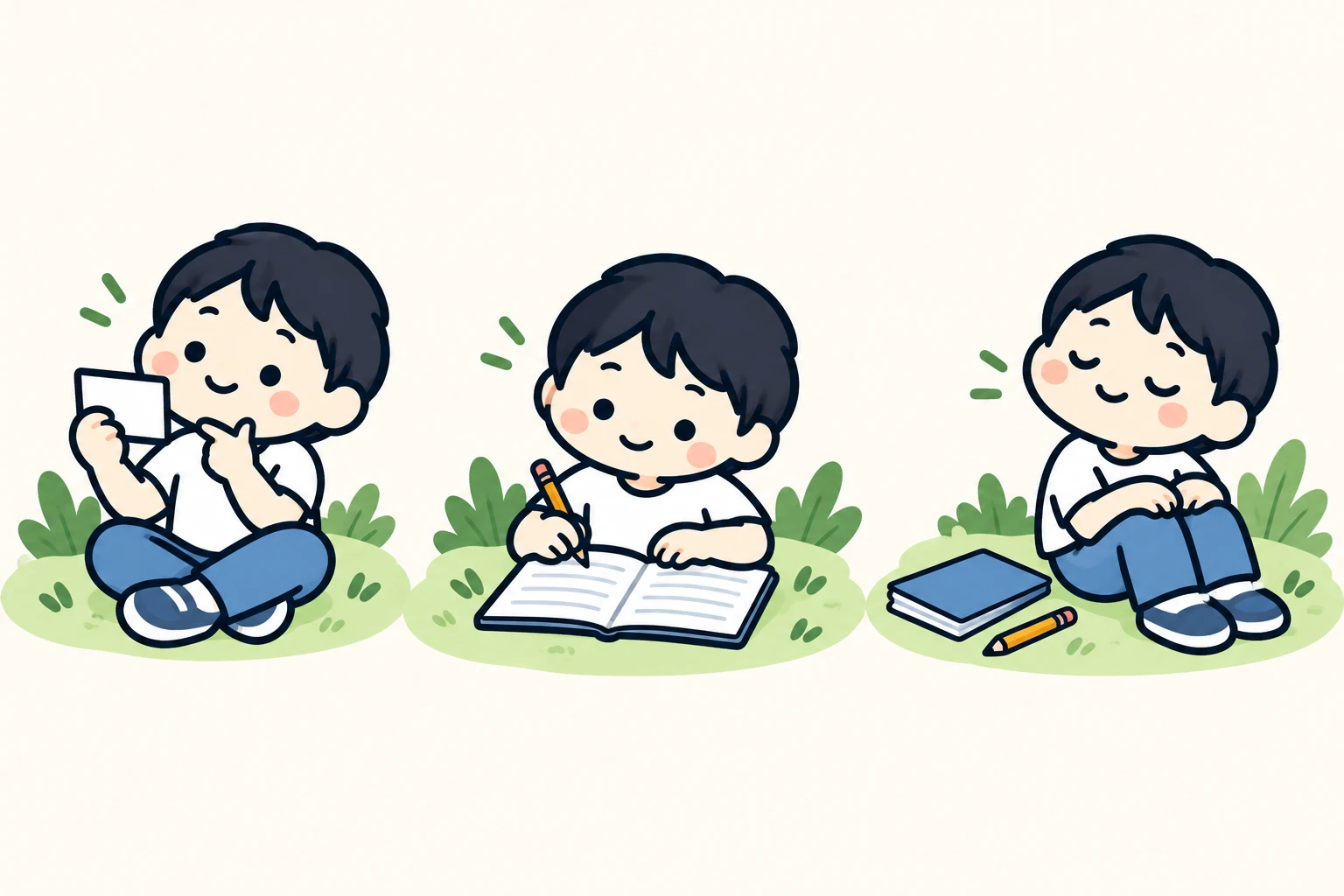
Four minutes: revisit familiar material. Try recalling a reading or meaning before revealing the answer. Check mistakes and practise the difficult items again.
Three minutes: learn something small. Choose a few words or one short sentence. Avoid opening another topic just because the first one feels difficult.
Two minutes: use what you learned. Read aloud, listen again, or answer a simple prompt. With the words above, try:
水をください。 — みずをください。 — Water, please.
The particle を is pronounced “o” here. Read the sentence aloud, then cover it and try recalling it from the English prompt.
One minute: leave tomorrow’s starting point. Write: “Tomorrow, review 水・お茶・本 before adding anything new.”
The useful ingredients are returning to material over time and attempting to recall it before checking. These approaches, spacing and retrieval practice, have strong research support. The exact minute-by-minute routine above is a suggested way to organise them. See The Learning Scientists’ guide to spacing and retrieval.
For more detail on the review itself, read our gentle guide to spaced repetition.
4. Prepare a smaller version for busy days
Some days, ten minutes won’t fit.
Choose a fallback in advance: Open my review, attempt three familiar items, check the answers, and stop.
This gives you a manageable option when your normal session feels too large. You can continue if you have time, but extra work isn’t required to make the session count.
5. Restart without creating a debt
If you miss a day, begin with a small review at your next opportunity.
You don’t need to double tomorrow’s workload. First, look at what got in the way:
- Was the chosen time regularly interrupted?
- Did the task require too much preparation?
- Were you adding new material faster than you could review it?
Change one thing. Move the session, prepare the materials, or reduce the amount.
Your first seven days
Use this week to test the routine. These are flexible planning prompts, not a seven-day habit-formation deadline.
Scroll sideways to read all table columns. You can also focus the table and use the arrow keys.
| Day | Focus |
|---|---|
| 1 | Choose your cue and complete one small session. |
| 2 | Begin by recalling yesterday’s material. |
| 3 | Notice what makes starting difficult. |
| 4 | Remove one obstacle. |
| 5 | Add one short reading or listening example. |
| 6 | Revisit difficult material before adding more. |
| 7 | Keep what worked and adjust what didn’t. |
At the end of the week, ask: What made it easier to start, and what can I remember now?
For your next session, choose just three familiar words. Pick when you’ll return to them, and leave them ready.